energy choices determine which energy efficient fridge freezer suits you: prioritize models with high energy ratings, watch for refrigerant leaks and overheating risks, and favor features that deliver lower bills and dependable food preservation so you save money and avoid hazards.
Size, layout and household usage
Space and layout affect efficiency: a too-large fridge wastes energy while a too-small one forces overstocking. You should match capacity and placement to your routine, and allow adequate ventilation and clearance for doors to open fully.
Choosing the right capacity for your household
Aim to choose capacity based on your household size and shopping habits; larger families need more freezer space, while singles can save energy with compact models. Prioritize usable internal litres and flexible shelving.
Interior layout, door style and placement considerations
Think about door style and placement: reversible or French doors suit tight kitchens, while side-by-side models offer storage but use more energy; ensure you can open doors fully without obstruction.
Additionally, check for sufficient clearance at the top and back for heat dissipation-placing the appliance near ovens, radiators or in direct sun raises energy use and risks compressor strain. Verify door swing and hinging so openings aren’t blocked, ensure a level, stable floor, and plan for a water connection if you want ice or filtered water.
Calculating lifetime cost and savings
Assess lifetime cost by adding purchase price, projected running costs, repairs and disposal over the fridge’s lifespan so you see true savings versus a cheaper model.
Estimating annual energy use and payback time
Estimate annual energy use from the label kWh figure adjusted for your settings and location, then divide the extra upfront cost by yearly energy savings to calculate payback time.
Incentives, warranties and expected maintenance
Factor in available rebates, manufacturer guarantees and routine upkeep; check warranty length, coverage for compressor and labor, and probable maintenance costs to avoid surprises.
Consider hunting for utility or government rebates and retailer offers you can apply to reduce upfront cost; confirm whether the manufacturer offers an extended warranty, its exclusions, transferability and service network. You should plan simple upkeep-clean condenser coils, check door seals and drains-to limit failures and unexpected repair bills, and include likely part and labor charges in your lifetime estimate.
Shopping guide – features and buying checklist
Next, when you shop prioritize energy rating and correct capacity to avoid wasted cycles; choose models with inverter compressors and superior insulation to cut running costs and emissions.
Must-have features for best energy performance
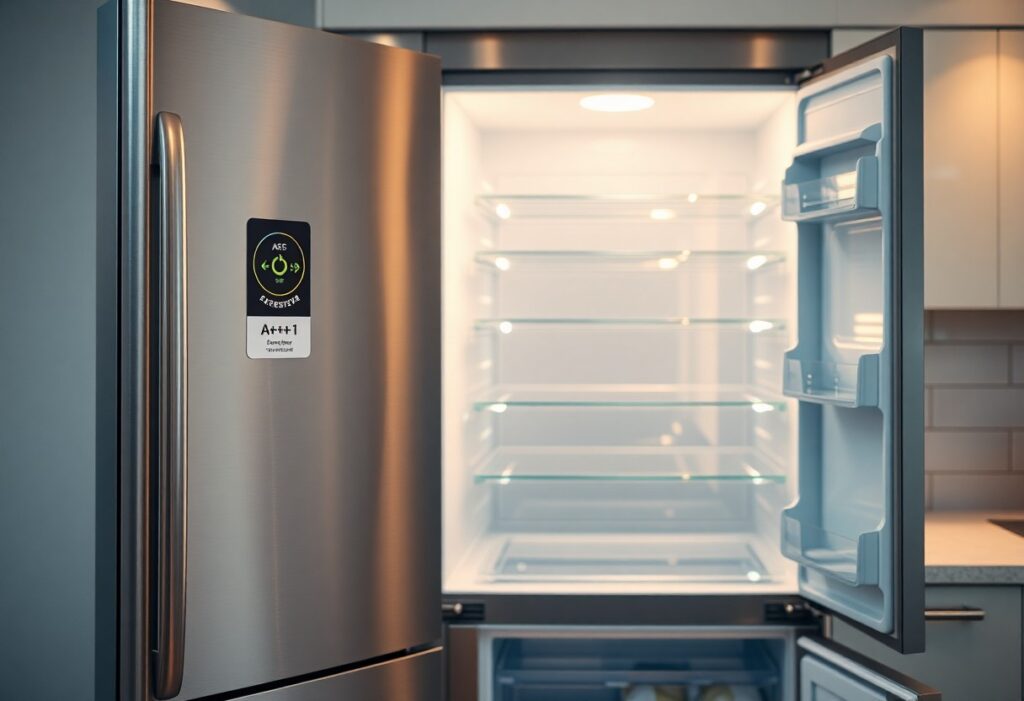
Consider features like an A+++ energy rating, high-quality door seals, adaptive thermostats, and efficient defrost systems to minimize consumption and maintain consistent temperatures.
Quick comparison checklist and tips for retailers
Compare label kWh, usable capacity, noise in dB, and warranty terms; ask about actual measured consumption and test performance at your typical ambient temperature.
- Energy rating: verify the kWh/year figure on the label.
- Capacity: choose usable litres that match your household.
- Compressor type: inverter compressors lower partial-load energy use.
- Knowing how real-world usage affects annual costs helps you evaluate value.
Quick comparison table
| Spec | Why it matters |
|---|---|
| kWh/year | Direct measure of annual energy consumption. |
| Usable capacity (L) | Affects cycling frequency and wasted energy. |
| Noise (dB) | Impacts installation location and user comfort. |
Additionally, when you inspect units, check door alignment, condenser access, and test the temperature stability; these affect long-term efficiency and repair risk.
- Warranty: longer coverage can reduce lifetime costs.
- Eco mode: useful for variable occupancy and savings.
- Defrost type: manual versus automatic influences energy use.
- Knowing which features impact maintenance and running bills guides your final choice.
Retailer checklist table
| Item | Retailer tip |
|---|---|
| Display model | Demonstrate door seals and temperature settings to customers. |
| Label transparency | Provide kWh examples based on typical usage scenarios. |
| Aftercare | Offer clear warranty and service options to reduce lifetime costs. |
To wrap up
From above, you should choose a fridge freezer with A+++ or equivalent energy rating, inverter compressor, good insulation, and right capacity for your household to maximize efficiency and savings.
FAQ
Q: Which features indicate a fridge-freezer is energy efficient?
A: Look for an up-to-date energy label (EU A-G scale or ENERGY STAR), low annual kWh on the label, and an inverter compressor for variable-speed operation. Good insulation (thick walls or vacuum insulated panels), tight door seals, LED lighting, accurate thermostats and separate temperature zones improve efficiency. Smart modes (eco or holiday), adaptive defrost and temperature sensors reduce runtime. Note that frost‑free models add convenience but can use slightly more energy than well-managed manual-defrost units.
Q: How do I choose the right size and configuration to maximize efficiency?
A: Match capacity to household needs-smaller units waste less energy when they meet your storage needs. Typical guidance: singles/couples often use 100-250 L fridge with 50-100 L freezer; families (3-4) 250-400 L fridge with 100-200 L freezer; larger households 400+ L fridge and 200+ L freezer. Choose layout based on usage: top-freezer models are often efficient, but compare labels rather than assuming. Built-in units can lose efficiency if ventilation is restricted-allow manufacturer-recommended clearances. Avoid oversized models and prioritize models with the energy features listed above.
Q: How can I estimate running costs and compare models effectively?
A: Use the annual kWh on the label and multiply by your electricity rate: annual cost = annual kWh × price per kWh. Example: 250 kWh/yr × $0.15/kWh = $37.50/yr. Also evaluate expected lifetime energy (annual kWh × years of ownership) and include any differences in convenience features that affect consumption. To minimize running costs, set fridge to about 3-4°C and freezer to −18°C, avoid placing hot food inside, keep door openings brief, clean condenser coils and door seals, and position the appliance away from heat sources and direct sunlight.