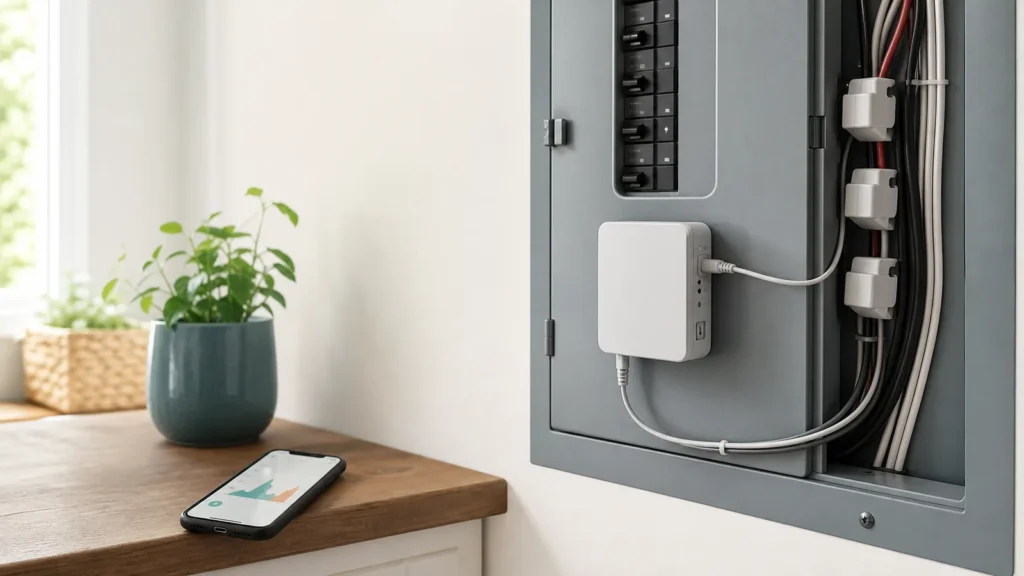
Quick answer: Emporia Vue 3 can fit a homeowner who needs panel-level visibility into total use or selected branch circuits and accepts an internet-connected app. It is a weaker fit for a renter, for a single plug-in appliance, or for someone who requires local-only data storage. This is a specification and evidence review, not a hands-on test.
What the Vue 3 is designed to measure
Vue 3 is installed at the electrical panel. The base configuration measures the service mains for a whole-home total or net value. Current manufacturer documentation says packages with branch sensors can monitor selected circuits, with support for up to 16 branch-circuit sensors from one monitor. That is valuable when the question concerns a known circuit, such as HVAC, water heating, an EV charger, solar production, or a pump.
This is categorically different from a plug-in meter. If you only need to test a receptacle-connected appliance, the simpler option is usually better; read plug-in meter vs whole-home monitor first.
Capabilities that matter in practice
| Capability | What it can help answer | Limit to keep in mind |
|---|---|---|
| Main-service monitoring | When total household demand rises or stays high | A total does not identify every appliance by itself |
| Optional branch-circuit sensors | How much a selected, known circuit uses | Sensor count, panel layout, and circuit access constrain coverage |
| App-based monitoring | Review patterns and compare before/after changes | Requires an active internet connection for key functions |
| Cloud data storage | Historical access through the platform | Not local-only storage; account and service dependency matter |
Important data and connectivity limitation
Emporia’s current product page states that Vue 3 requires an active internet connection for real-time monitoring, cloud storage, and automatic software updates, and that it does not support local data storage. Treat that as a buying requirement, not a footnote. Before purchase, confirm the current data-export, account, retention, privacy, integration, and service terms for your country and use case.
Who it is likely to fit
- Owners with an accessible, compatible panel and a specific whole-home or hardwired-circuit question.
- Households trying to verify the timing of HVAC, water heating, EV charging, pumps, solar, or other known high-load circuits.
- People who will review the data and make a measurable operating, repair, or scheduling change.
- Users comfortable with an internet-connected product account and cloud-held historical data.
Who should look for another method first
- Renters or anyone without property-owner approval for panel work.
- People testing one ordinary plug-in appliance.
- Buyers who require local-only data storage or who do not want a vendor-service dependency.
- Anyone expecting the monitor alone to diagnose a mechanical problem or guarantee bill savings.
Installation is a real part of the decision
The product is installed in or at an electrical panel, and the exact service type, panel layout, conductor access, sensor placement, and local rules determine whether it is suitable. Emporia’s technical documents describe supported electrical systems and sensor limits; its installation materials direct users to qualified electrical help when appropriate. Service mains may remain live even when a main breaker is off. Do not use an article or video as instructions to work inside a panel.
How to evaluate the result after installation
- Label every directly measured circuit correctly.
- Record a normal week before changing schedules or equipment.
- Use the monitor to establish timing and runtime patterns, not to assume a fault.
- Make one practical change, then compare a comparable period using kWh and your actual rate.
- Bring unusual circuit patterns to the relevant HVAC, plumbing, solar, or electrical professional.
For a stubborn bill, begin with the high-electric-bill diagnosis process. A monitor may show an old AC circuit running for long periods, for example, but long AC runtime has multiple possible causes.
Our verdict
Vue 3 makes the most sense as a measurement tool for a real, hardwired-load question—not as a universal money-saving gadget. Its circuit-level option is more informative when you can measure the relevant circuit directly. Its cloud dependence is a material tradeoff. If the question is narrower, use the cheaper and simpler measurement method instead.
Sources
- Emporia: Vue 3 product specifications, connectivity, and package options
- Emporia Help Center: sensor types and circuit placement
- Emporia: Vue 3 technical sell sheet
- U.S. Energy Information Administration: measuring electricity
Affiliate disclosure: This article contains no product affiliate links at publication. We have not been supplied a verified physical-product affiliate path for Emporia or other monitor hardware.
Editorial method: Product specifications, app capabilities, support policies, and availability can change. This page reports current manufacturer documentation checked on July 16, 2026; it is not a hands-on test or a guarantee of compatibility.