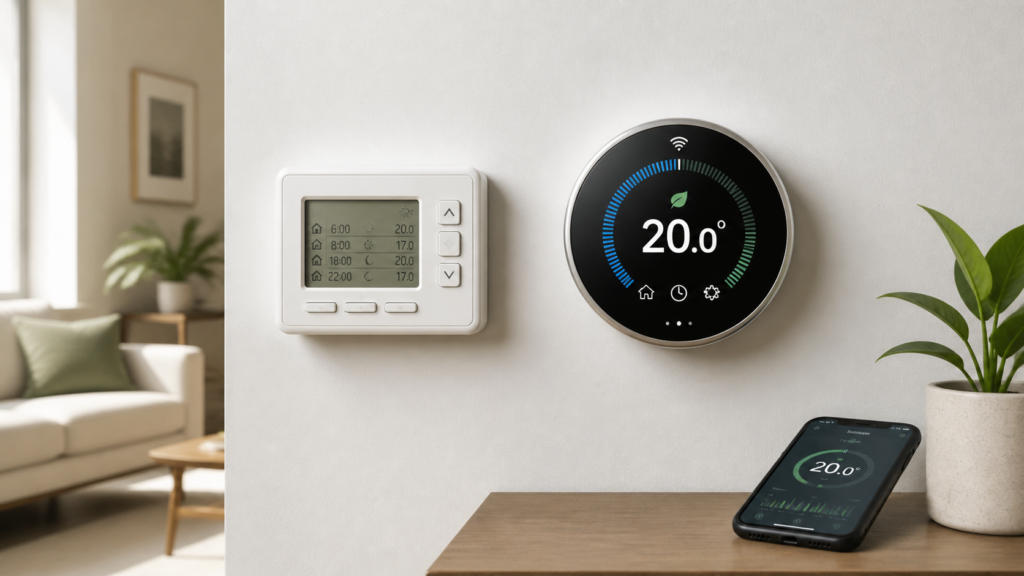
A smart thermostat is usually the better choice when you want remote control, automatic schedule adjustments, occupancy features, or energy-use feedback. A programmable thermostat is often the better value when your routine is predictable and you only need a reliable time-and-temperature schedule. Neither type is automatically more efficient in every home. Compatibility, setup, and how consistently the schedule is used matter more than the label on the box.
Editorial note: This comparison is based on ENERGY STAR and U.S. Department of Energy resources. We did not conduct hands-on testing of every thermostat, and this page currently contains no affiliate purchase links. Product features and compatibility can change, so confirm the exact model and HVAC system before buying.
If you already know you need connected controls, our Smart Home Energy guide hub explains how thermostats fit with sensors, monitoring, and other home controls. This page focuses on whether connected automation is worth paying for compared with a schedule-only thermostat.
Smart thermostat vs. programmable thermostat at a glance
| Feature | Programmable thermostat | Smart thermostat |
|---|---|---|
| Basic control | Runs heating and cooling from a schedule entered at the wall control. | Runs heating and cooling locally, with connected features added. |
| Scheduling | Fixed daily or weekly periods that you edit manually. | App-based schedules; some models can adjust using occupancy, location, or learned patterns. |
| Remote access | Usually no. | Usually available through an app and internet service. |
| Reports and alerts | Limited or absent. | May include runtime history, filter reminders, unusual-temperature alerts, or suggestions. |
| Internet dependency | None for normal operation. | Basic thermostat control should remain local, but app, weather, voice, and remote features may stop offline. |
| Complexity | Lower once the schedule is entered. | More setup, account, network, permission, and feature decisions. |
| Best fit | Stable routine and simple setback periods. | Changing routine, remote property access, sensors, or useful automation. |
What is a programmable thermostat?
A programmable thermostat changes temperature settings according to time periods you enter. A common schedule might use one setting while the household is awake, another while people are away, a comfort setting in the evening, and a setback overnight. Depending on the model, weekdays and weekends may share a schedule or use separate programs.
The key point is that the thermostat follows the programmed timetable. It normally does not know whether somebody came home early, whether the building is unexpectedly empty, or whether tomorrow’s routine is different. You update the schedule at the wall control when life changes.
This simplicity can be a strength. There is no app account, cloud service, location permission, or home Wi-Fi connection to maintain. For a household with consistent work and sleep hours, a well-designed schedule may provide the control that is actually needed without adding features that will go unused.
What is a smart thermostat?
A smart thermostat combines thermostat control with network connectivity and software. ENERGY STAR describes smart thermostats as devices that let users control heating and cooling settings from a phone, tablet, or computer through a wireless connection. Many models also offer features such as occupancy sensing, learning, reminders, geofencing, weather information, or energy-use reports.
“Smart” does not mean every model has every feature or that automation will always make the correct decision. One model may emphasize remote access; another may use room sensors; another may focus on utility programs or learning. Compare the exact functions rather than assuming all connected thermostats behave alike.
ENERGY STAR-certified smart thermostats have an additional evidence gate: certification is based on field data showing energy savings, and the key product criteria require normal thermostat operation when connectivity to the service provider is unavailable. That does not guarantee the same result in every home, and connected features still depend on the model’s app, network, and service.
Which one can save more energy?
Both types can reduce unnecessary heating or cooling when they create useful setbacks. Both can also save little when the schedule is poorly matched to occupancy, when users frequently override it, or when the building and HVAC system have larger problems.
A smart thermostat has more ways to keep the schedule aligned with real life. Remote changes can help when travel plans change. Occupancy or location features may avoid conditioning an empty home. Runtime reports may reveal that equipment is operating longer than expected. These functions can make savings easier to maintain, but only if they are compatible, enabled, and appropriate for the household.
A programmable thermostat can perform just as well for a stable schedule that is entered correctly and left in use. Paying for automation does not create an automatic return. Climate, insulation, equipment efficiency, previous temperature habits, utility rates, and backup-heat operation all affect the bill.
If the bill has already jumped, do not assume a new thermostat is the cure. Start with the high-electric-bill checklist and, when control behavior looks suspicious, use our thermostat fault guide.
Scheduling and automation
A programmable thermostat is predictable: it performs the schedule you entered. That is useful when the household follows repeatable hours and wants direct control. The weakness appears when the schedule is never updated after work, school, travel, or occupancy patterns change.
A smart thermostat can make schedule changes easier from an app, and some models can adjust based on presence or learned behavior. That flexibility is valuable for irregular hours, frequent travel, a second home, or a property where another person may need remote help. It can also create frustration when an automatic feature changes temperatures unexpectedly. Buyers should confirm that learning, geofencing, and utility-event features can be reviewed, adjusted, or disabled.
Wi-Fi, privacy, and operation during an outage
A programmable thermostat does not need an internet account for normal scheduling. This is attractive when privacy, long-term independence, or network simplicity is a priority.
A smart thermostat may collect device, home, occupancy, location, or runtime information to provide connected features. The exact data depends on the manufacturer and enabled services. Read the current privacy policy, check account-security options, and decide whether location-based automation or voice-assistant integration provides enough value to justify the permission.
If Wi-Fi or the cloud service is unavailable, basic local temperature control should continue on an ENERGY STAR-certified smart thermostat, but app control, remote notifications, weather data, voice commands, and some automations may not. Confirm offline behavior for the exact product; “works without Wi-Fi” does not mean every smart feature remains available.
Compatibility matters more than features
Do not choose either thermostat from a feature list alone. Check whether the system is conventional or a heat pump, the heating and cooling stage count, auxiliary or emergency heat, dual-fuel control, zoning, accessories, voltage, and the current terminal labels.
Many connected thermostats need continuous 24-volt power through a C wire or a manufacturer-approved power accessory. Our no-C-wire smart thermostat guide explains the supported alternatives. A programmable model may use batteries, system power, or both, but that does not establish HVAC compatibility.
Heat pumps need a model that correctly controls the O/B reversing valve, compressor stages, and backup heat. Use the dedicated smart thermostat for heat pump compatibility guide before applying general advice from this comparison.
Proprietary communicating systems, many ductless mini-splits, electric baseboard heat, and other line-voltage equipment may not accept a common retail 24-volt thermostat. Stop and identify the control architecture if the existing terminals or voltage do not match the candidate thermostat.
Choose a programmable thermostat when…
- Your weekday and weekend routines are consistent.
- You want scheduled setbacks without an account or internet connection.
- You prefer fewer settings, permissions, integrations, and services.
- You are comfortable updating the schedule manually when routines change.
- The model explicitly supports your HVAC equipment and wiring.
Choose a smart thermostat when…
- You need to check or change temperatures away from home.
- Your schedule changes often enough that a fixed program is frequently wrong.
- Room sensors, occupancy, geofencing, alerts, or runtime reports solve a specific problem.
- You want to review compatible rebates or voluntary utility programs.
- You accept the account, network, privacy, and software-maintenance requirements.
- The exact thermostat passes the manufacturer’s HVAC compatibility process.
Pre-purchase checklist
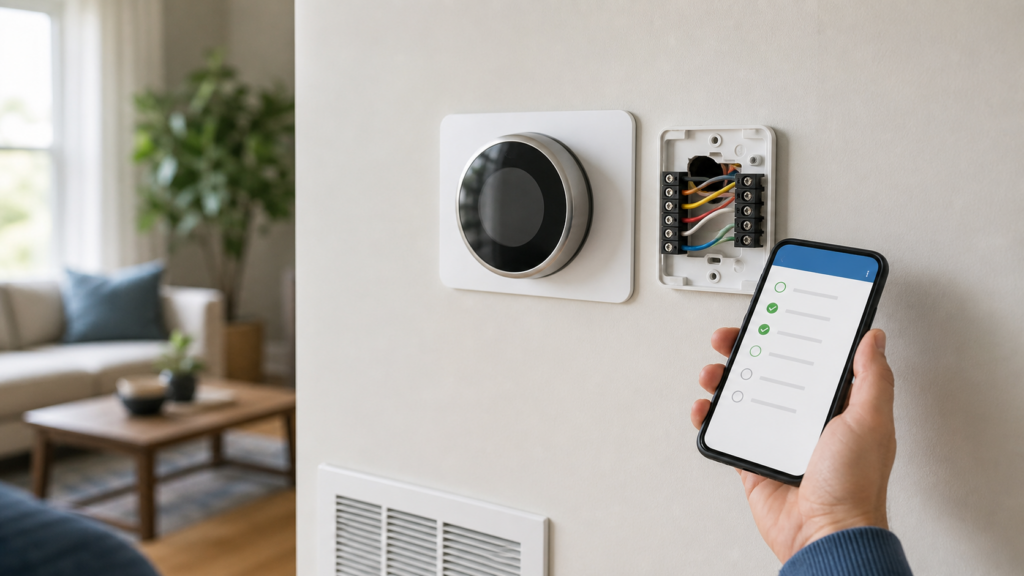
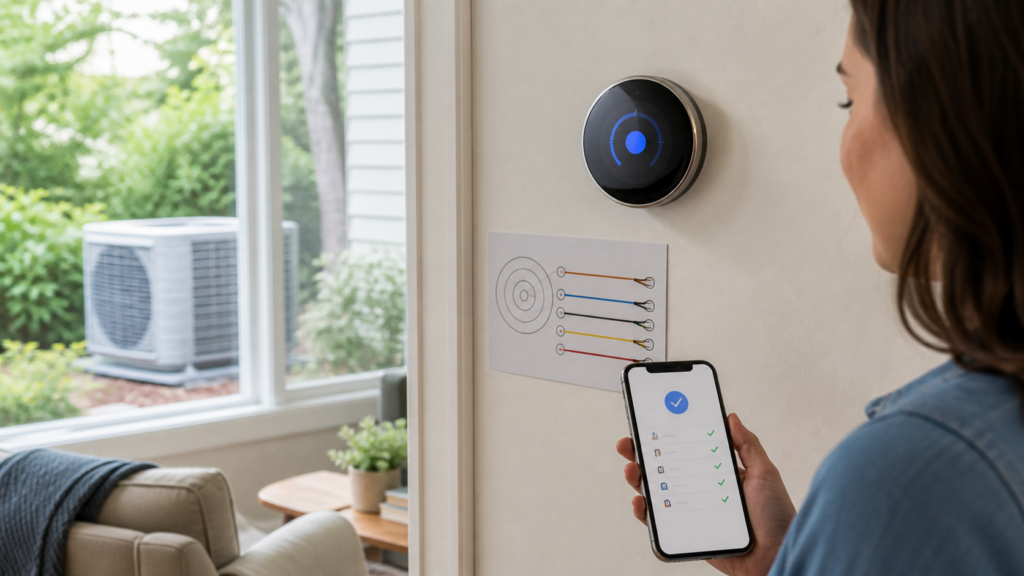
- Photograph the existing thermostat terminals before disconnecting anything.
- Identify conventional HVAC, heat pump, dual fuel, zones, communicating control, or line voltage.
- Record heating, cooling, and backup-heat stages.
- Check for a connected C wire and the exact model’s power requirements.
- Run the terminal arrangement through the manufacturer’s compatibility checker.
- List the connected features you will actually use; ignore features that do not solve a real need.
- Review privacy, offline operation, software support, and account-security options.
- Check current ENERGY STAR certification and local rebates for the exact model.
- Use qualified HVAC or electrical help for uncertain wiring, line voltage, dual fuel, zones, or proprietary controls.
Frequently asked questions
Is a smart thermostat the same as a programmable thermostat?
No. Both can follow schedules, but a smart thermostat adds network-connected functions such as app control and may add occupancy, learning, alerts, reports, or integrations. A programmable thermostat normally follows a schedule entered locally.
Is a smart thermostat worth the extra cost?
It can be when remote access or automation keeps the schedule accurate, prevents unnecessary operation, or provides useful alerts. It may not be worth it for a stable routine when a simple program is used consistently.
Does a programmable thermostat work without Wi-Fi?
Yes. A conventional programmable thermostat normally runs its local schedule without Wi-Fi. Check whether it uses batteries, HVAC power, or both.
Will a smart thermostat still heat or cool without internet?
Basic local thermostat control should remain available on an ENERGY STAR-certified model, but remote access and other connected functions may stop. Verify the exact product’s offline behavior.
Can either thermostat work with a heat pump?
Only if the exact model supports the heat pump’s reversing valve, stages, backup heat, power, and control design. “Programmable” or “smart” alone is not proof of compatibility.
Primary sources
- ENERGY STAR smart thermostat certification and buying guidance
- ENERGY STAR smart thermostat key product criteria
- U.S. DOE Building Science Education: programmable thermostats
Bottom line: A programmable thermostat is the sensible low-complexity choice for a predictable schedule. A smart thermostat earns its higher complexity when remote access, adaptive scheduling, sensors, alerts, or reporting will actually be used. Whichever type you choose, confirm compatibility and program it around real occupancy rather than expecting the device name to lower the bill.