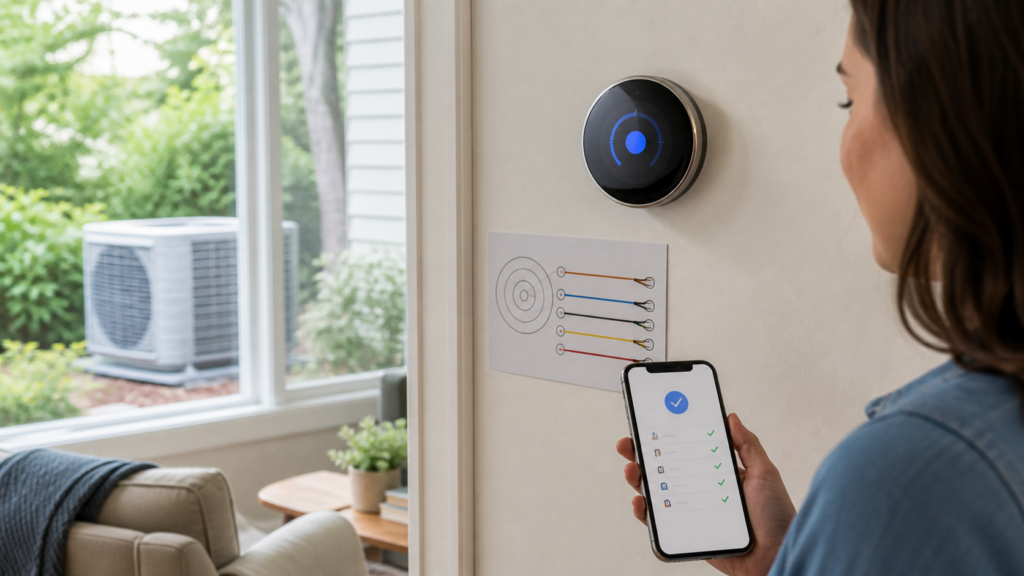
The best smart thermostat for a heat pump is not simply the model with the most features. It must support the heat pump’s reversing valve, heating and cooling stages, auxiliary or emergency heat, and—when applicable—dual-fuel controls. A thermostat that works perfectly with a conventional furnace and air conditioner can be the wrong choice for a heat pump.
Editorial note: This is a compatibility guide based on manufacturer documentation and ENERGY STAR guidance. We did not conduct hands-on testing of every thermostat, and this page currently contains no affiliate purchase links. Specifications and bundles can change; confirm the exact model before buying.
For the broader role of schedules, sensors, monitoring, and automation, see our Smart Home Energy guide hub. If you have not decided whether connected features are useful, start with the smart thermostat vs. programmable thermostat comparison. This article focuses only on the heat-pump compatibility decision.
Why heat pumps need a different thermostat check
A conventional system normally uses separate heating and cooling equipment. A heat pump moves refrigerant in different directions to provide both functions. The thermostat may therefore need to control an O/B reversing valve, one or more compressor stages, a fan, auxiliary heat, and emergency heat.
That distinction affects both comfort and cost. If a thermostat is configured for the wrong reversing-valve behavior, the equipment may cool when it should heat. If stage or auxiliary-heat control is wrong, expensive resistance heat may run unexpectedly or required backup heat may not operate correctly. A product label that merely says “smart thermostat” does not establish compatibility.
Six things to identify before buying
- System type: air-source heat pump, geothermal heat pump, mini-split, packaged unit, or another configuration.
- Reversing-valve terminal: look for O, B, or O/B at the existing thermostat and in the equipment documentation.
- Stage count: record compressor stages and the number/type of backup-heat stages.
- Backup heat: distinguish electric auxiliary heat, emergency heat, and a dual-fuel furnace.
- Power: determine whether a connected C wire exists or whether the manufacturer supports an adapter/power accessory for the exact system.
- Control architecture: identify standard 24 VAC terminals versus proprietary communicating or line-voltage controls.
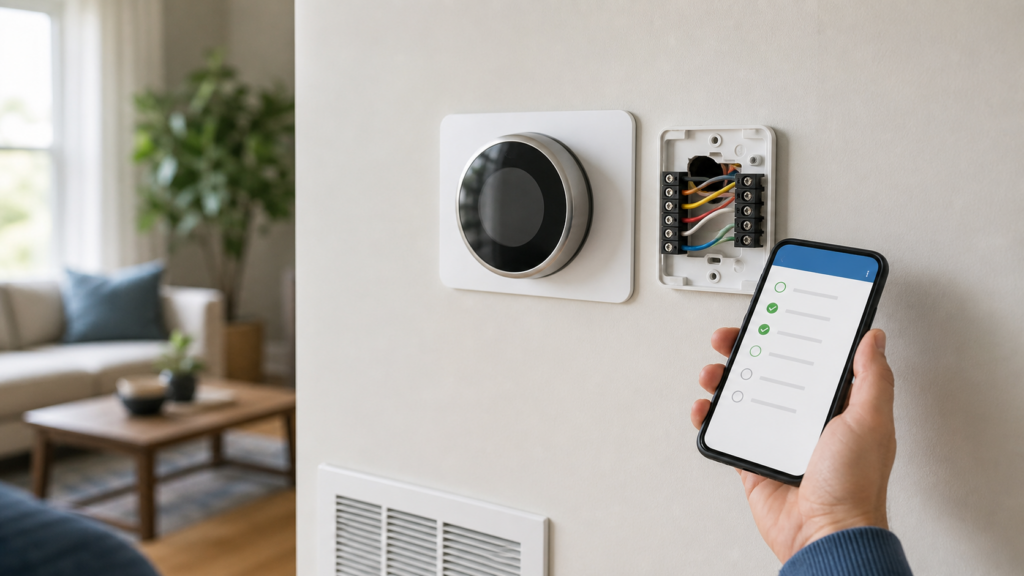
Photograph the existing terminals and equipment labels before disconnecting anything. Wire colors are not a reliable substitute for terminal letters because installers may use different conventions.
Smart thermostat options for heat pumps
| Thermostat path | Verified boundary | Check before buying | Best fit |
|---|---|---|---|
| ecobee Smart Thermostat Enhanced | Official specifications list most 24 VAC heat pumps up to 2H/2C plus one stage of AUX heat. | Stage count, AUX requirements, power, accessories, and dual-fuel needs. | A compatible standard 24 VAC heat pump within that documented boundary. |
| Google Nest thermostat family | Heat-pump support is model- and system-dependent; Google provides a wiring compatibility checker. | O/B, AUX/E, stages, C-wire or Power Connector result, and proprietary controls. | Buyers whose exact terminals pass Google’s model-specific checker. |
| Copeland Sensi family | Compatibility varies by model; Copeland provides HVAC and auxiliary-heat guidance. Sensi Smart and Lite require a C wire for heat-pump use. | Exact Sensi model, C-wire requirement, stages, and AUX behavior. | A configuration confirmed by Copeland’s compatibility process. |
| Honeywell Home T9 | Official specifications list up to 3 Heat/2 Cool stages; the package includes a C-wire adapter. | Whether those terminals match the exact heat pump, backup heat, and dual-fuel arrangement. | Homes that match the T9’s supported wiring and want an adapter included. |
ecobee Smart Thermostat Enhanced
ecobee provides one of the clearest published compatibility boundaries. The Smart Thermostat Enhanced product specifications say it works with most 24 VAC HVAC equipment, including heat pumps up to 2H/2C plus one stage of auxiliary heat.
That statement is useful because it identifies a real limit rather than saying only “works with heat pumps.” It still does not cover every heat pump. A system with additional stages, proprietary communication, multiple accessories, or complex dual-fuel control may fall outside the boundary. Run the actual terminal arrangement through ecobee’s checker before choosing the model.
Good match: standard 24 VAC equipment within the documented stage limits.
Pause and verify: additional AUX stages, dual fuel, communicating equipment, or unusual accessories.
Google Nest thermostat family
Google Nest compatibility depends on the thermostat model and the exact HVAC wiring. Do not use a general statement about one Nest model to approve another. Record all terminals—including O/B, AUX, E, and C—and use Google’s compatibility checker for the specific thermostat.
The power result matters too. Some compatible Nest installations can operate without an existing C wire, while others require a C wire or Nest Power Connector. Our smart thermostat without a C wire guide explains that separate decision. For a heat pump, the no-C-wire rule must never replace the heat-pump compatibility check.
Good match: the exact wire set and heat-pump configuration passes Google’s checker.
Pause and verify: dual fuel, multiple backup stages, zones, or a Power Connector requirement.
Copeland Sensi thermostat family
Copeland provides model-specific compatibility and auxiliary-heat settings guidance. This is important because no-C-wire behavior differs between conventional systems and heat pumps. Sensi Smart and Sensi Lite may work without a C wire on many conventional combined heating-and-cooling systems, but Copeland requires a C wire when those models are used with a heat pump.
Do not treat all Sensi models as having the same power and stage support. Confirm the exact model, heat-pump wiring, auxiliary-heat arrangement, and available common wire.
Good match: a model/system combination confirmed by Copeland’s checker and installation documentation.
Pause and verify: assuming the conventional-system no-C-wire rule applies to a heat pump.
Honeywell Home T9
The Honeywell Home T9 product page lists support for up to 3 Heat/2 Cool stages and includes a C-wire adapter in the package. Those specifications make it a candidate for some staged systems, but the stage numbers alone do not establish compatibility with every heat pump.
Confirm how the product assigns O/B, compressor, AUX, and emergency-heat terminals for the actual equipment. A dual-fuel system may need outdoor-temperature logic, furnace lockout, or equipment-specific controls beyond a simple stage count.
Good match: the current Honeywell documentation confirms the terminal arrangement.
Pause and verify: treating “3 Heat/2 Cool” as universal approval for any heat pump.
What the O/B reversing-valve terminal means
The reversing valve changes the refrigerant flow so a heat pump can switch between heating and cooling. Some equipment energizes the valve in cooling; other equipment energizes it in heating. Thermostats commonly use an O, B, or combined O/B terminal and a configuration setting to control this behavior.
Do not guess the setting from climate, brand familiarity, or wire color. Use the heat-pump and previous-thermostat documentation. After installation, follow the manufacturer’s test procedure for both heating and cooling. If the system delivers the opposite mode, turn it off and correct the configuration according to the official instructions or obtain professional help.
Auxiliary heat versus emergency heat
Auxiliary heat is backup heat that the system may call automatically when the heat pump cannot meet demand or when controls determine that additional capacity is needed. In many all-electric systems, this is electric resistance heat and can use substantially more power while operating.
Emergency heat is a mode that generally stops normal compressor heating and relies on the backup source. It is not an everyday efficiency setting. The exact behavior depends on the equipment and controls.
A compatible thermostat must understand the required terminals and stages. If a high bill follows frequent backup-heat operation, use our heat pump high electric bill checklist to investigate temperature, defrost, airflow, equipment faults, and control settings before replacing the thermostat.
Dual-fuel systems need extra care
A dual-fuel system combines a heat pump with a combustion furnace. Controls decide when to operate the heat pump, when to switch to the furnace, and whether both can run under particular conditions. That may depend on outdoor temperature, balance point, equipment lockouts, and manufacturer-specific logic.
Do not assume that a thermostat supporting electric AUX heat also supports the dual-fuel sequence in your home. Confirm explicit dual-fuel compatibility and the installation design. This is a strong reason to use a qualified HVAC professional.
C wire, adapters, and power extenders
Wi-Fi thermostats need continuous power. A connected C wire is the most direct path for many installations, while some manufacturers support a model-specific connector or power-extender kit. Heat-pump rules can be stricter than conventional-system rules because more terminals and control functions are involved.
Never free a terminal or combine wires using an unofficial workaround merely to make a thermostat power on. Verify the equipment-side control board and use only a supported accessory for the exact thermostat and system.
Communicating, mini-split, and line-voltage controls
Some HVAC systems use proprietary communicating thermostats instead of standard 24 VAC terminals. Many ductless mini-splits use their own wired or wireless controllers. Electric baseboard and some other heating systems use line-voltage thermostats. A common retail 24 VAC smart thermostat may not be directly compatible with any of these.
If the existing wall control has proprietary labels, only two communication wires, or a voltage rating outside typical 24 VAC controls, stop and identify the system before purchasing. An interface module may exist, but it needs manufacturer approval and correct installation.
Safe installation and test checklist
- Use the manufacturer’s compatibility checker with the exact terminal photo.
- Confirm heat-pump type, stage count, O/B behavior, AUX/E, and dual-fuel status.
- Shut off HVAC power as directed before removing the thermostat cover or moving wires.
- Label each wire by terminal—not only by color—and preserve the original photo.
- Install only the supported C-wire adapter or power accessory specified for the model.
- Configure equipment type and stages exactly as documented.
- Test fan, cooling, heating, and backup heat using the manufacturer procedure.
- Watch runtime and comfort over several representative days; do not treat one hour as an energy result.
Seek qualified help for uncertain terminals, dual fuel, zones, proprietary controls, line voltage, damaged wiring, burning odor, arcing, or repeated breaker trips.
ENERGY STAR, savings, and rebates
ENERGY STAR says certified smart thermostats are independently certified using actual field data to save energy. That is a useful evidence gate, but it is not a promise that every home will save the same percentage. Results depend on climate, previous schedule, occupancy, equipment, backup-heat use, and how the thermostat is configured.
Check the ENERGY STAR Product Finder and local utility rebate programs for the exact model. If a bill is already abnormal, start with the high electric bill diagnostic guide and the thermostat fault checklist. A new thermostat cannot repair poor airflow, a refrigerant problem, failed defrost controls, inadequate insulation, or oversized equipment.
Frequently asked questions
Will any smart thermostat work with a heat pump?
No. It must support the heat pump’s O/B reversing valve, stages, backup heat, power requirement, and control architecture.
Do heat pumps require a special smart thermostat?
They require a thermostat explicitly compatible with the exact heat-pump configuration. A compatible retail model may work for standard 24 VAC equipment, while communicating or complex systems may require a manufacturer control.
Can the wrong thermostat make a heat-pump bill higher?
Incorrect configuration can affect mode, stages, runtime, or backup heat. But a high bill can also come from weather, rates, airflow, equipment faults, defrost behavior, or building heat loss. Diagnose the pattern before assigning the cause.
Does a heat pump smart thermostat need a C wire?
Many do. Some model/system combinations support a manufacturer power accessory, but rules differ. For example, Copeland requires a C wire for Sensi Smart and Lite heat-pump applications even though those models may operate without one on many conventional combined systems.
Should I use large temperature setbacks with a heat pump?
Setback behavior depends on equipment, thermostat recovery logic, climate, and backup heat. A setback that triggers substantial resistance heat can undermine the intended saving. Follow the heat-pump and thermostat guidance and compare runtime under similar weather.
Primary sources
- ENERGY STAR smart thermostat certification and buying guidance
- Daikin: smart thermostat and heat-pump compatibility
- ecobee Smart Thermostat Enhanced specifications
- Google Nest thermostat wiring and power guidance
- Copeland Sensi HVAC compatibility guidance
- Copeland Sensi C-wire requirements
- Copeland Sensi auxiliary-heat settings
- Honeywell Home T9 specifications
Bottom line: Choose a smart thermostat only after the exact heat pump passes the model-specific compatibility check. O/B, stages, backup heat, dual fuel, power, and control architecture matter more than app features.