A dehumidifier’s electricity cost depends on its power draw, how long it actually runs, and your electricity rate. A unit plugged in for 24 hours does not necessarily run its compressor for 24 hours. Start with measured kilowatt-hours (kWh), rather than assuming that every appliance of the same capacity costs the same amount.
Quick calculation: electricity cost = measured kWh × your applicable price per kWh. If you only have watts and running hours, use watts ÷ 1,000 × hours as an estimate. The examples below are hypothetical calculations, not product tests or a prediction for your home.
How much electricity does a dehumidifier use?
There is no single wattage that represents every portable or whole-home dehumidifier. Check the exact model’s documentation, then measure its consumption when possible. Its compressor may cycle, and fan-only operation can have a different power draw. A reading taken at one moment therefore cannot tell you the entire day’s consumption.
The U.S. Energy Information Administration explains the difference between power and energy: watts describe power, while kWh accounts for power used over time. For a cycling appliance, a meter’s accumulated kWh is usually more useful for cost calculations than multiplying one instantaneous reading by every hour it is plugged in.
Calculate the daily and monthly running cost
Use your bill or tariff to find the charge that changes when you use an additional kWh. Do not include a fixed monthly customer charge as though it increases with each appliance. Tiered rates, time-of-use pricing, taxes and variable charges can make a single-rate estimate approximate.
| Assumed average power during counted hours | Hours per day | kWh per day | Daily cost | 30-day cost |
|---|---|---|---|---|
| 300 W | 4 | 1.2 | $0.24 | $7.20 |
| 500 W | 8 | 4.0 | $0.80 | $24.00 |
| 500 W | 24 | 12.0 | $2.40 | $72.00 |
These assumed wattages are not a typical range, manufacturer specifications, or measured results. The last row assumes a constant 500 W for every hour, which is not the same as leaving a cycling unit switched on all day. If your meter reports 2.6 kWh over 24 hours, the estimate at this example rate is 2.6 × $0.20 = $0.52 for that day, regardless of the appliance’s nameplate wattage.
What does it cost to run overnight?
Measure the actual overnight interval. For example, an assumed average draw of 400 W across eight hours equals 3.2 kWh, or $0.64 at the example rate. Do not assume an overnight timer is automatically appropriate: check whether humidity remains controlled and follow the model’s operating instructions.
Why pints per day do not tell you the wattage
Capacity describes moisture removal under specified conditions, not electricity use. ENERGY STAR explains that capacity is commonly expressed in pints per 24 hours, while Integrated Energy Factor (IEF) expresses liters of water removed per kWh. Higher IEF indicates better efficiency on that metric; it does not guarantee a particular monthly bill. See ENERGY STAR’s dehumidifier buying guidance for these distinctions.
Compare models using compatible test ratings and the exact specifications. A larger capacity number alone is not proof of higher operating cost, nor is a smaller model automatically the least expensive solution. The useful question is how much electricity the equipment needs to maintain the required conditions in your space.
What can make running costs increase?
- More operating time. Persistent moisture can keep the appliance working for longer.
- A lower humidity setting. Trying to maintain a different target may change runtime; choose an appropriate setting rather than simply the lowest number.
- Moisture entering the space. Open doors or windows and unresolved water ingress can undermine the task.
- Operating conditions. Room temperature, airflow and equipment condition matter. Check the specified temperature range and maintenance instructions.
ENERGY STAR recommends keeping doors and windows closed while dehumidifying, maintaining suitable airflow, and reducing moisture sources. Its guidance also describes humidistat cycling once the selected humidity level is reached. These are operating considerations, not a promised percentage reduction in your home’s bill.
A practical seven-day electricity check
- Record the model and setting. Note the humidity target, operating mode and room conditions. Do not change every variable at once.
- Choose a safe measurement method. Use a plug-in meter only if both the appliance instructions and meter specifications allow the load, including compressor starting current. Otherwise ask a qualified professional about an appropriate method.
- Log accumulated kWh. Record start and end readings over a known period, ideally several representative days. Record interruptions such as a full bucket or a power outage.
- Calculate the cost. Divide total kWh by the number of measured days for the daily average, then apply your actual rate. A 30-day projection is an estimate, not a guarantee for wetter or colder weather.
- Make one sensible change. Address an identified moisture source or follow a recommended maintenance step, then compare similar periods. Do not mistake a drier week for proof that a setting saved energy.
For choosing the measurement method, see plug-in meter versus whole-home energy monitor. A whole-home total includes other loads, so it cannot isolate this appliance’s consumption without additional information.
Reduce unnecessary use without ignoring moisture
Check drainage and maintenance according to the manual, keep air passages clear, and investigate persistent moisture instead of continually lowering the setting. For whole-home installations or recurring building moisture problems, use an appropriately qualified contractor. A running-cost calculation is not a substitute for diagnosing leaks or evaluating building conditions.
Keep water drainage away from electrical connections and use the electrical connection required by the manufacturer. Do not open electrical panels, bypass protection, or improvise wiring to measure consumption. ENERGY STAR’s safety guidance specifically separates drainage from electrical equipment and calls for a properly grounded outlet.
Frequently asked questions
Does a dehumidifier use a lot of electricity?
It can become a noticeable load when it runs for long periods, but “a lot” depends on measured kWh relative to the rest of your home. Compare the appliance’s measured consumption with your bill, rather than attributing an entire increase to it. Start with the high-electric-bill checklist if the cause is unclear.
Is it cheaper to run a dehumidifier at night?
Only a different applicable electricity price or a different consumption pattern makes the arithmetic cheaper. With time-of-use rates, separate consumption by tariff period. A lower rate does not justify allowing unsuitable moisture conditions during the rest of the day.
Can a smart plug measure or control it?
Not every smart plug measures energy, and not every plug is suitable for a compressor load. Verify the specific device and appliance instructions, including behavior after power is restored. Do not assume a generic timer or remotely switched socket is an approved control.
Should I replace my dehumidifier to save money?
Measure first. Compare a suitable replacement’s specifications and purchase cost with your existing unit’s actual consumption. Efficiency ratings alone cannot establish payback for your conditions. Our home energy-saving device guide explains why the right tool depends on the problem.
Next step: measure the appliance, then choose the fix
Record a representative period of kWh and the rate used in your calculation. If the unit’s consumption is small compared with the bill increase, investigate other loads instead of buying a replacement immediately. Explore the heating, cooling and appliance guides for related equipment questions.
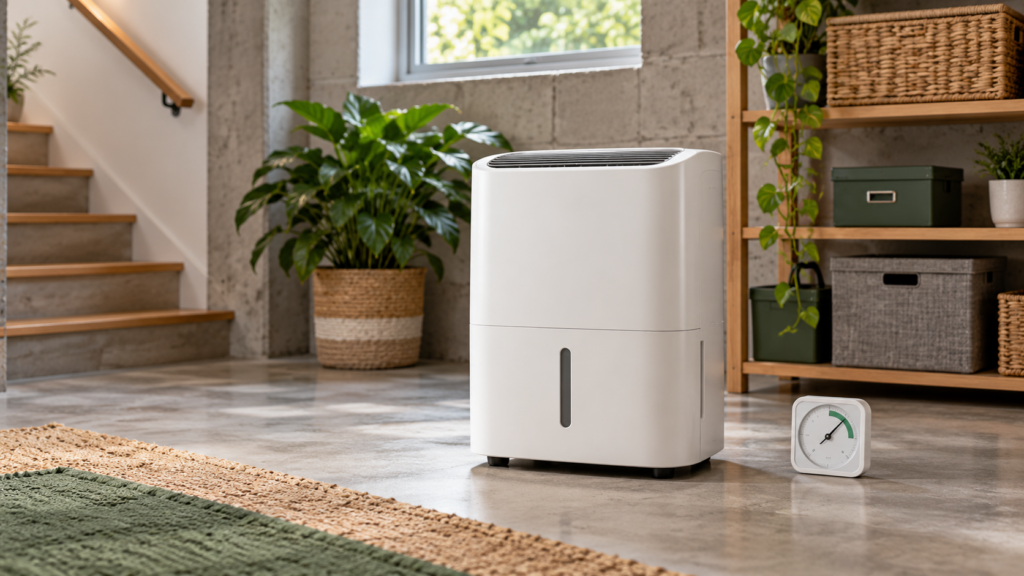
Editorial note: this is general educational guidance. Numerical examples are hypothetical, and the cover is an AI-generated illustration, not evidence of a product test. No product purchase or savings outcome is guaranteed.