Quick answer: An electric water heater can cause a high electric bill when hot-water use increases, a leak continually draws replacement water, the thermostat or controls malfunction, sediment or equipment condition increases runtime, or a heat-pump model relies heavily on resistance elements. Water heating is a major household load, so confirm its operating pattern rather than dismissing it as standby use.
First verify that the increase is in kWh rather than only price or billing days. Our high-electric-bill guide provides the whole-home sequence; this page isolates the water-heating branch.
Why a water heater can move the bill noticeably
Every gallon of hot water must be heated from the incoming-water temperature to the setpoint. Storage heaters also replace heat lost through the tank and connected piping. The U.S. Department of Energy reports that water heating is responsible for roughly 13% of annual residential energy use and consumer utility costs, although the share varies widely by household, fuel, climate, and equipment.
A sudden increase usually comes from more gallons, a larger temperature rise, more standby loss, or longer operation caused by a fault. A consistently high bill may instead reflect an inefficient equipment type, an old tank, or normal high demand.
Common water-heater causes of high electricity use
1. A hot-water leak
A dripping hot faucet, leaking shower valve, failed relief-valve discharge, or hidden plumbing leak can make the heater replace hot water around the clock. Look for unexplained water use, warmth where pipes should be cool, moisture, or a meter that moves when every fixture and appliance is off. Never cap or disable a temperature-and-pressure relief valve.
2. More hot-water demand
Guests, longer showers, colder weather, a new large tub, more laundry, or a dishwasher setting can increase energy use without any fault. Incoming water is often colder in winter, requiring more energy for the same outlet temperature.
3. A thermostat or control problem
Electric storage heaters commonly use thermostats to control heating elements. A failed control, wiring fault, or incorrect setting can cause abnormal operation, but internal testing exposes high voltage and should be performed by a qualified person. Warning signs include dangerously hot water, no hot water, repeated breaker trips, or continuous operation inconsistent with demand.
4. Heat-pump water heater mode
Heat-pump models may use electric resistance elements in high-demand, boost, emergency, or certain temperature conditions. DOE purchasing guidance notes that resistance mode has higher operating cost and should be used only when necessary. Check the operating mode and error history before assuming the heat pump itself has failed.
5. Tank, pipe, or installation losses
An older tank with higher standby loss, long uninsulated hot-water runs, recirculation that operates continuously, or hot piping routed through cold spaces can increase demand. Follow manufacturer and local-code guidance before adding insulation, especially near controls, combustion equipment, vents, and relief components.
6. Sediment or equipment deterioration
Mineral accumulation and component condition can affect performance and service life. Maintenance requirements differ by model and water chemistry. Follow the manufacturer’s instructions; do not drain, open, or service a heater without understanding burn, pressure, electrical, and water-damage risks.
A safe diagnostic sequence
- Compare kWh and water use. If both electricity and water rose, investigate occupancy, fixtures, and leaks.
- Check for visible leaks. Inspect around fixtures, the tank, drain pan, discharge pipe, and accessible hot-water piping without touching electrical components.
- Review recent changes. Note guests, new schedules, colder weather, appliance changes, and recirculation settings.
- Check user-accessible controls. Confirm the displayed mode and setpoint using the manual. Do not remove access covers.
- Use interval data. Repeated demand when no one uses hot water can justify a plumbing or electrical inspection.
- Get measured service data. A professional can check elements, controls, current draw, wiring, leaks, temperature, and system condition.
Can you measure the water heater separately?
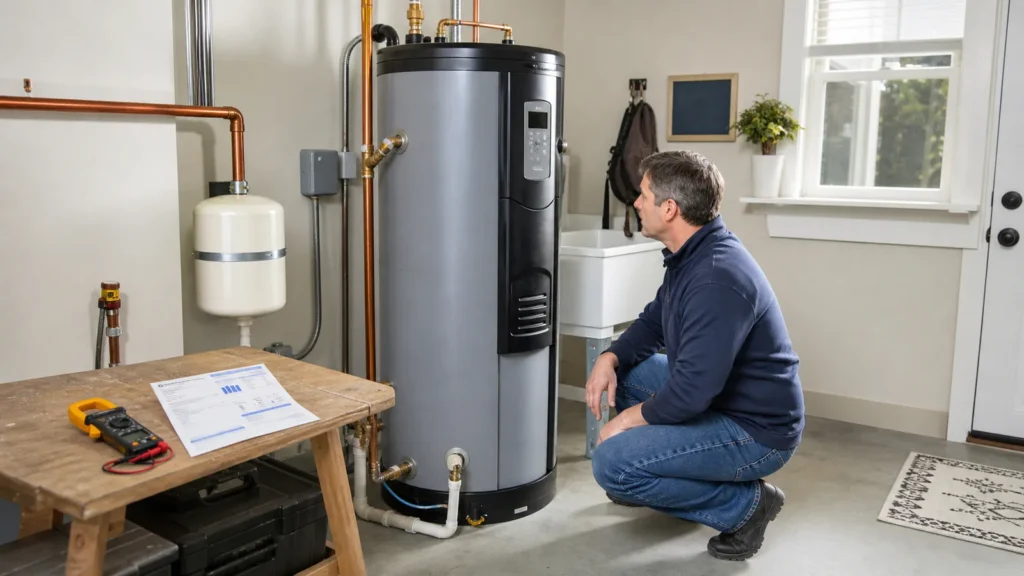
Most tank water heaters are hardwired and cannot be tested with a normal plug-in meter. Utility interval data may show heating cycles, but other loads can overlap. A properly installed circuit monitor can isolate the water-heater circuit. Learn the differences in our home-energy-monitor guide.
Never place improvised meters inside a panel or around conductors. Panel-mounted current sensors belong within the product’s instructions and local electrical rules.
When repair makes sense—and when to compare replacement
A repair may be reasonable for a serviceable unit with a clear replaceable fault and a sound tank. Replacement deserves consideration when the tank leaks, repairs are recurring, parts are unavailable, capacity no longer matches the household, or the lifetime operating-cost comparison favors a different technology.
ENERGY STAR states that certified heat-pump water heaters use substantially less electricity than standard electric resistance models. Actual savings depend on household size, hot-water demand, climate, installation location, electricity price, operating mode, and installed cost. Check noise, condensate, space, airflow, recovery, and electrical requirements—not only the advertised annual savings.
Low-risk ways to reduce water-heating demand
- repair hot-water leaks promptly;
- use efficient showerheads and fixtures that still provide acceptable performance;
- run full dishwasher and laundry loads where appropriate;
- use vacation mode for extended absences when the manufacturer supports it;
- avoid unnecessarily high setpoints while maintaining health and household needs; and
- control recirculation by demand or schedule instead of operating it continuously where practical.
Call a qualified professional when
- water is excessively hot, the relief valve discharges, or the tank leaks;
- the breaker trips or wiring, controls, or insulation smell overheated;
- a heat-pump model reports repeated faults or stays in resistance mode;
- you suspect a hidden hot-water leak; or
- the work requires opening electrical covers, testing live circuits, or modifying plumbing.
Bottom line
A water heater can be the reason for a high bill, but the useful question is why it is using more energy: increased demand, colder inlet water, leaks, control problems, operating mode, standby losses, or equipment condition. Use the bill, water meter, interval pattern, and professional measurements to separate those causes.
Sources
- U.S. Department of Energy: residential water-heater efficiency standards and energy use
- U.S. Department of Energy: purchasing and operating residential water heaters
- ENERGY STAR: heat-pump water heaters
- ENERGY STAR: hot-water distribution and point-of-use systems
Editorial note: This article provides general information and does not replace electrical, plumbing, or equipment diagnosis. It contains no product affiliate links at publication.