Quick answer: An old air conditioner can contribute to a high electric bill, but age alone is not proof. The bill rises when the system needs more electrical energy or more runtime to remove the same amount of heat. Dirty coils, restricted airflow, low refrigerant, duct leakage, poor sizing, extreme weather, and changes in thermostat use can produce the same symptom. Compare weather-adjusted usage and system runtime before deciding that replacement is the answer.
If the increase affects the whole bill rather than only cooling season, begin with our high-electric-bill diagnostic guide. The steps below focus specifically on cooling.
How an aging AC can increase electricity use
An air conditioner moves heat from indoors to outdoors. Its compressor, outdoor fan, and indoor blower use electricity while the system runs. A unit may draw more energy over a billing period because it runs longer, cycles inefficiently, or has lost capacity. The visible symptom is often a house that takes longer to cool, uneven temperatures, poor humidity control, or a system that rarely shuts off during weather that it previously handled comfortably.
Older equipment can also have a lower original efficiency rating than a well-selected current system. However, replacing an old unit does not automatically produce the advertised savings. Climate, electricity price, duct condition, installation quality, equipment size, and household settings all affect the result.
Seven signs the AC deserves closer investigation
- Runtime has increased under comparable weather. Use thermostat runtime reports, utility interval data, or a daily log. Compare similar outdoor temperatures rather than unrelated calendar months.
- The house no longer reaches the setpoint. This can indicate reduced capacity, restricted airflow, duct loss, an equipment fault, or an unusually high heat load.
- Rooms have become uneven. Closed registers, damaged ducts, insulation problems, or changes to the building can imitate an AC failure.
- The system short-cycles. Repeated starts and stops can come from control, sizing, airflow, refrigerant, or electrical problems and deserve professional diagnosis.
- Coils or filters are dirty. ENERGY STAR notes that dirty coils reduce cooling ability and make equipment run longer, while a dirty filter restricts airflow and wastes energy.
- Cooling costs rise without a matching weather explanation. Compare cooling degree days or local temperature history as well as kWh.
- Repairs are becoming frequent. ENERGY STAR lists equipment over ten years old, rising bills, and frequent repairs as signals that replacement may be worth evaluating—not as an automatic replacement rule.
Checks you can do without opening the equipment
Compare kWh, not only dollars
A higher rate or longer billing period can raise the total even when the AC uses the same amount. Record the bill’s kWh, number of days, rate, and average outdoor temperature. If your utility provides hourly or 15-minute data, look for the daily cooling pattern and overnight baseload.
Inspect the filter and airflow
Follow the equipment manufacturer’s filter instructions. Check that supply and return grilles are open and unobstructed. Do not assume that a more restrictive filter is always better for an existing blower; filtration and pressure drop must suit the system.
Check the outdoor unit from a safe distance
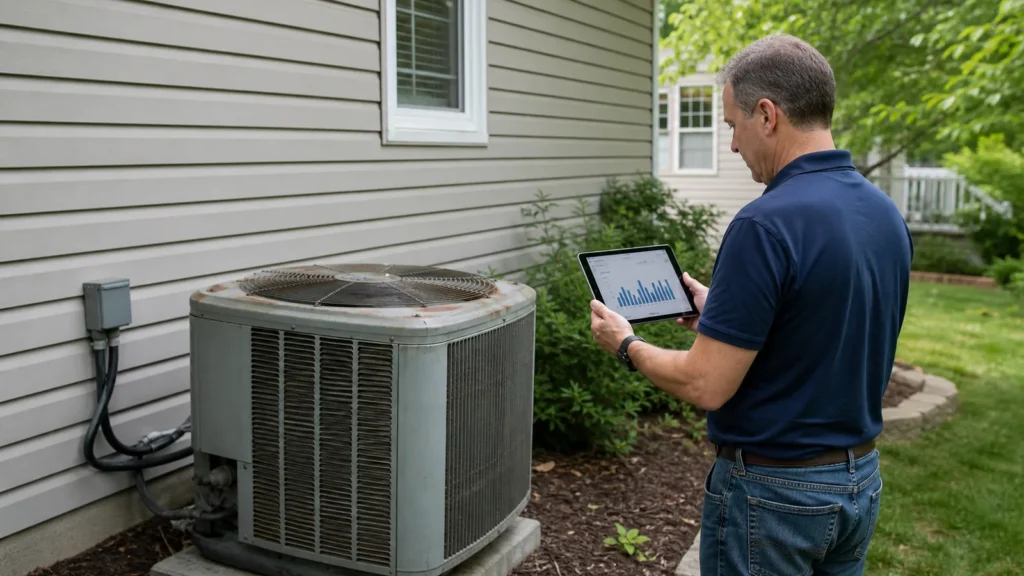
Remove loose leaves and obvious obstructions around the condenser while the equipment is off, following the manufacturer’s clearance guidance. Do not remove panels, touch electrical components, bend refrigerant tubing, or spray chemicals into the unit.
Verify thermostat behavior
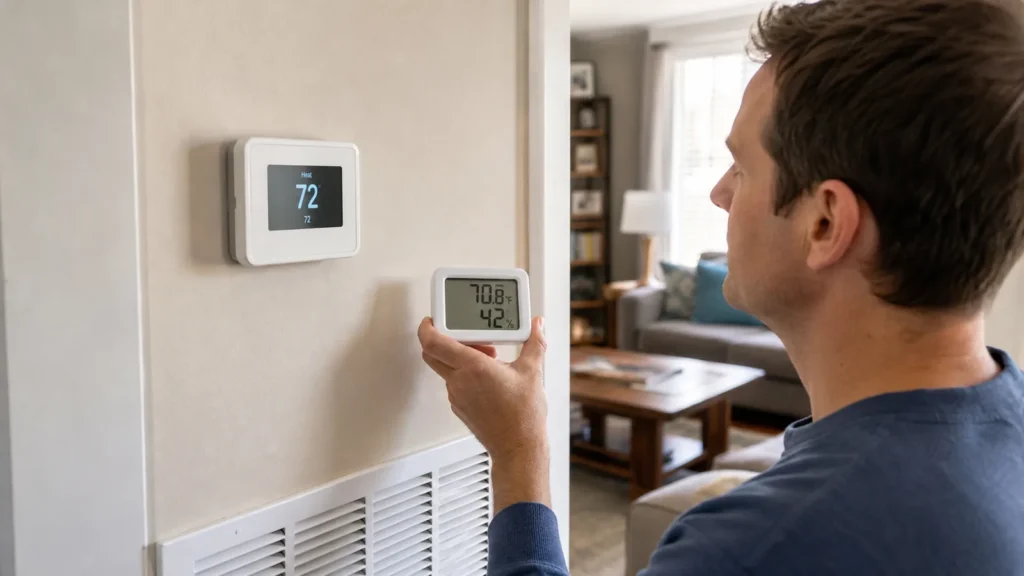
Confirm the mode, schedule, setpoint, fan setting, and any temporary holds. A thermostat exposed to direct sun, a lamp, television, supply-air draft, or an unrepresentative room can make the system run differently. If displayed temperature disagrees materially with a reliable thermometer after both have stabilized, continue with our faulty-thermostat diagnostic.
When maintenance may be enough
A professional tune-up should address airflow, coil condition, condensate drainage, electrical connections, controls, refrigerant charge, and safe starting and shutdown. ENERGY STAR specifically identifies dirty coils, incorrect refrigerant level, and blower problems as causes of lower efficiency or longer runtime.
Maintenance cannot turn an inherently inefficient or badly sized system into a new high-efficiency design, but it can correct avoidable losses. Ask the contractor to record measurements and explain the fault rather than recommending replacement based only on age.
When replacement deserves a calculation
Compare repair cost, expected remaining life, current measured performance, replacement efficiency, installation changes, utility incentives, and comfort problems. Include duct sealing or air sealing when those are part of the load. A high-efficiency outdoor unit connected to poor ducts or installed at the wrong capacity can underperform.
Use our efficient-air-conditioner guide to understand sizing and ratings. Request an actual load calculation rather than allowing the existing nameplate size to determine the replacement automatically.
How to measure whether the AC is the main load
Utility interval data can reveal long blocks of increased demand during hot hours. Some smart thermostats report HVAC runtime, while a professionally installed circuit monitor can measure the AC circuit directly. A plug-in meter cannot measure most central systems because they are hardwired or use higher-voltage circuits.
Read whether a home energy monitor is worth it before buying one. Monitoring identifies patterns; it does not repair the cause or guarantee savings.
Call a qualified HVAC professional when
- the breaker trips, wiring smells hot, or the equipment makes new electrical or grinding sounds;
- the indoor coil or refrigerant line freezes;
- the system cannot control temperature or humidity;
- there is suspected refrigerant loss, damaged ductwork, or repeated short-cycling; or
- you need electrical, refrigerant, combustion, or internal equipment testing.
Do not open energized equipment or handle refrigerant. Follow local licensing and electrical requirements.
Bottom line
An old AC can raise a bill when declining performance, lower design efficiency, or longer runtime increases kWh. Prove the pattern with usage, weather, runtime, and measured system condition. Correct maintenance and building problems first, then compare repair and replacement using realistic assumptions.
Sources
- ENERGY STAR: HVAC maintenance checklist
- ENERGY STAR: clean heating and cooling
- U.S. Department of Energy: spring and summer energy-saving tips
Editorial note: This guide provides general diagnostic information, not a remote diagnosis of your equipment. It contains no product affiliate links at publication.